


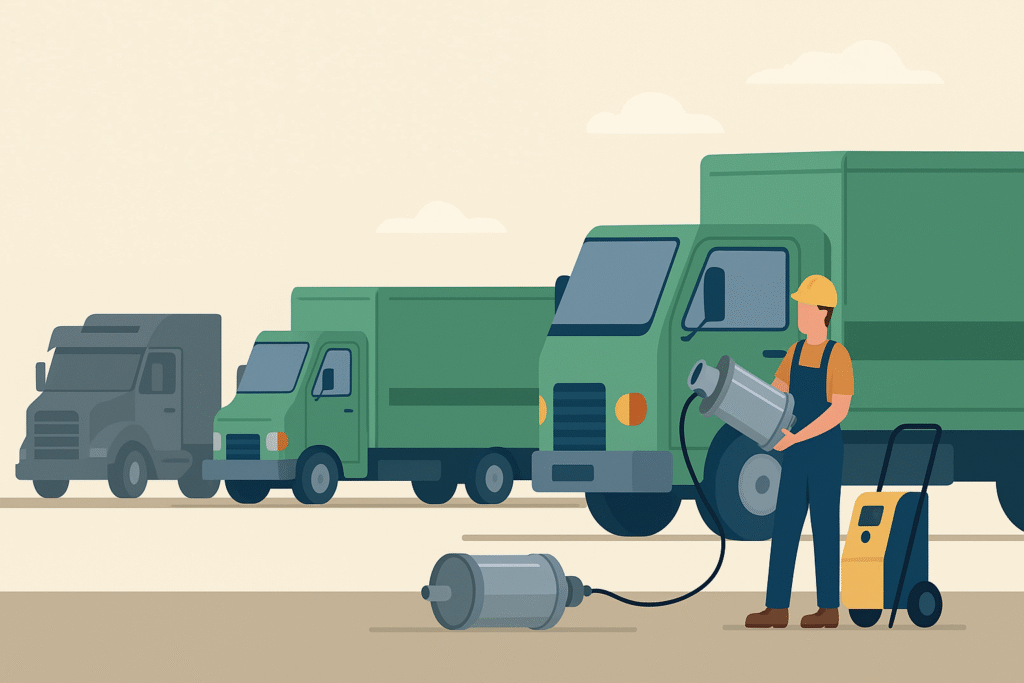
There are several strategies that can be applied, depending on the company's operations:
 Preventive maintenanceplanned interventions at defined intervals (e.g. oil change, brake inspection, DPF cleaning every 100,000 km).
Predictive maintenancebased on data analysis (sensors, telemetry) that anticipates failures before they occur.
Corrective maintenancerepair after a breakdown. It is the most costly and causes the most downtime.
Regulatory maintenance: legally required revisions to comply with safety and emissions regulations.
According to industry studies, maintenance of the aftertreatment system (including DPF) is already more expensive than tyres in modern trucks. In addition, ignoring DPF cleaning intervals can multiply the risks of serious failures such as turbochargers, injectors or even complete engines.
Implementing a preventive plan allows:
Reduce overall costs.
Increase fleet availability.
Extending the service life of vehicles.
Comply with emissions regulations.
The diesel particulate filter (DPF) is one of the most critical and expensive elements of modern vehicles. Its function is to trap soot and ash from combustion, but it requires periodic regeneration and deep cleaning at specific intervals.
Regenerationsburn the soot, but do not remove the ash
Professional cleaningEvery 100,000-150,000 km for delivery trucks and every 200,000-300,000 km for long distance.
CostsA new DPF can cost more than €2,500, while a professional cleaning costs around €200-600, making preventive maintenance a minimal investment compared to replacement.
Long distance: every 150,000-200,000 km.
Local and urban distribution: every 80,000-100,000 km.
Severe duty (rubbish, mining, city buses): every 50,000-75,000 km.
👉 These intervals prevent critical ash accumulations that can break down filter ceramics and generate costs of up to 1 million euros per year in large fleets.
Schedule preventive maintenance with software or telemetry.
Train drivers: they are the first line of alert.
Controlling the use of DEF (urea) in vehicles with SCR systems, avoiding pollution and efficiency losses.
Check for oil, coolant or gasket leaks, which damage the DPF.
Perform periodic back pressure and air flow tests on filters.
Opt for reliable DPF cleaning suppliers instead of remanufactured parts of dubious quality.
Reduction of TCO (Total Cost of Ownership).
Less downtime: a filter can be cleaned in hours, while a repair can take weeks.
More safety on the road: vehicles in better condition.
Environmental compliance: you avoid penalties for excessive emissions.
The fleet maintenance is not an expense, but an investment in reliability, savings and competitiveness. Scheduling DPF cleanings, training drivers and implementing preventive strategies are key steps to ensure that your fleet is always working at peak performance.
At DPF REVIVAL we help workshops and fleets to implement professional DPF filter cleaning solutionsThe new system reduces costs and extends the service life of the vehicles.
 Want to know more? Visit our guides to:

Specialists in the design and manufacture of DPF cleaning machines and catalytic converter cleaning machines.
DPF REVIVAL: Solutions for the cleaning of particulate filters

Copyright © 2026 Iberisa Asesoramiento Gestión y Servicios S.L.

 Español
 Español de Chile
 Español de México
 English (UK)
 Français
 Deutsch
 Português
 Italiano
 Română
 Polski
 Русский